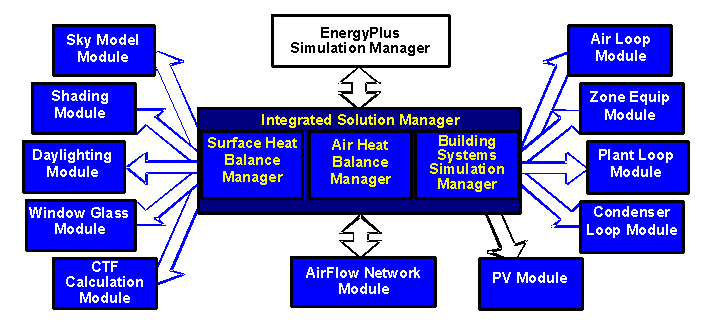
در صفحه ۶۲ کتاب engineering reference انرژی پلاس، روش CTF به صورت کامل توضیح داده شده. بخشی از متن را براتون آوردم.
Conduction transfer functions are an efficient method to compute surface heat fluxes because they eliminate the need to know temperatures and fluxes within the surface. However, conduction transfer function series become progressively more unstable as the time step decreases. This became a problem as investigations into short time step computational methods for the zone/system interactions progressed because, eventually, this instability caused the entire simulation to diverge. This phenomenon was most apparent for thermally massive constructions with long characteristic times and, correspondingly, requiring a large number of terms in the CTF series. This indicates that the problem is related to round-off and truncation error and is in no way an indictment of the CTF method itself. Methods that develop CTF series from finite difference approximations to the heat conduction equation (Meyers, 1980; Seem, 1987) were considered to address this problem. Seem’s method did give better accuracy and stability at short time steps than the current BLAST technique but, the method still had difficulty computing stable CTF series for time steps of less than 1/4 hour for the heaviest constructions in the BLAST library.

 E Fallahi